

Diabetes Foot Assessment in Newcastle
A 30-minute painless check by a podiatrist that catches problems early — before they become serious. Recommended annually for anyone with diabetes, and often rebatable under a Medicare GP chronic condition plan.
Rebatable with GP care plans · HICAPS on-site · No GP referral required · Same-week appointments
Why diabetic foot checks matter
If you have diabetes, your feet need attention they didn't need before. The reason is straightforward: persistently high blood glucose damages two things — the nerves in your feet (so you stop feeling small injuries) and the blood vessels feeding them (so anything that does happen heals slowly).
That combination is why diabetes is the leading cause of non-traumatic lower limb amputations in Australia. But here's the part that's often missed: nearly all of those amputations start with something small — a blister, a tiny cut, an ingrown toenail — that a person didn't notice or didn't treat in time. Annual foot assessments exist specifically to catch those small things early, when they're still easy to fix.
You're at higher risk if you:
Have had diabetes for many years
Have had blood glucose levels that have been hard to control
Smoke (or did in the past)
Have reduced sensation in your feet
Have already had a foot ulcer or infection
Have peripheral vascular disease or other circulation issues
If any of those apply, you may need more frequent assessments than once a year. We’ll work that out together.
What happens at your foot assessment
The whole appointment takes about 30 minutes. There's nothing painful, no needles, no surprises. Here's the breakdown:
1. Skin & nail inspection
We start by looking at your feet — top, bottom, between the toes, and the heels. We're checking for any cuts, calluses, corns, dry or cracked skin, nail problems, signs of infection, and any colour or temperature changes. Many people with diabetes have small issues they haven't noticed because the sensation in their feet has dropped.


2. Nerve sensation testing
We test the nerves in your feet using a thin nylon filament (a "monofilament") and a small tuning fork. The filament tests your ability to feel light pressure; the tuning fork tests your ability to feel vibration. Both are completely painless. Together they tell us whether peripheral neuropathy has started — and if so, how advanced.
3. Circulation assessment
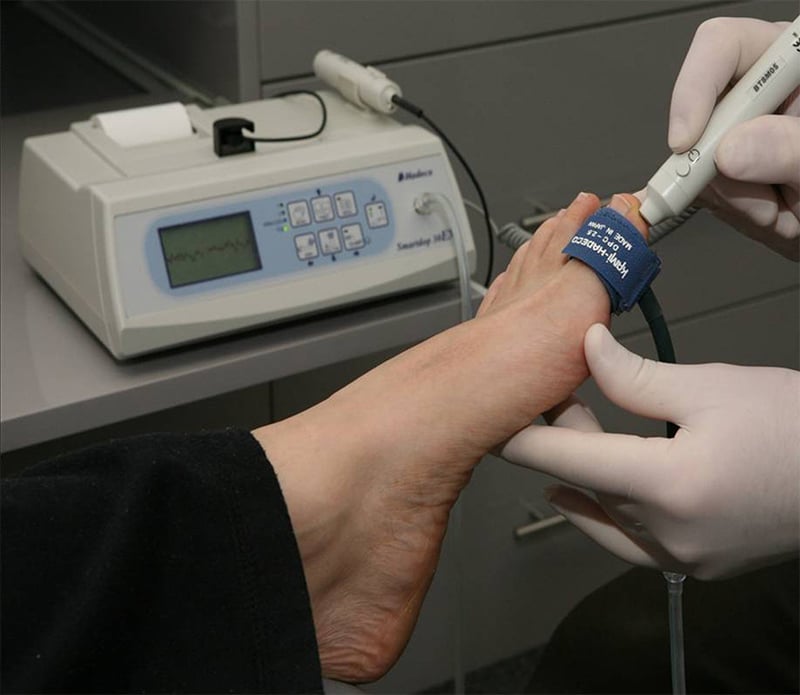
We check the pulses in both feet by hand and, where indicated, with a small handheld Doppler ultrasound. Good blood flow means good healing; reduced blood flow is a warning sign we want to know about. If we find anything concerning, we'll communicate that back to your GP.

4. Foot shape & pressure points
We look at how your feet are loaded when you stand and walk. Areas of high pressure (especially under the ball of the foot or the big toe) become the future sites of ulcers if they're not addressed. Sometimes this is solved with simple footwear changes; sometimes with custom orthotics or pressure-relief insoles.
5. Risk categorisation & your care plan
At the end of the assessment we'll categorise your feet as low, medium, or high risk — using the standard Diabetes Australia framework. You'll leave with a clear plan: how often to come back, what to monitor at home, any specific concerns we've flagged, and what to do if something changes. We'll send a copy to your GP if you'd like, so it's part of your broader diabetes care record.

Medicare GP chronic condition plans — your assessment may be rebatable
If you've been diagnosed with diabetes, you may be eligible for a GP Chronic Condition Management Plan — previously called a CDM or EPC (Enhanced Primary Care) plan. It's organised through your GP and gives you access to up to 5 allied health appointments per calendar year with Medicare contributing to the cost.

Diabetes foot assessments are one of the most common uses of these GP plans. With a valid GP referral under the plan:
Medicare contributes a rebate towards each visit
You don’t need to wait until you have a problem — the plan covers preventative care
What to do: book a longer appointment with your GP and ask about a GP Chronic Condition Management Plan with a referral for podiatry. They’ll send the referral directly to us. If you don’t have a plan, you can still see us as a private patient — we have HICAPS on-site if you have private health extras cover.
We also see patients under DVA and NDIS — please call us to discuss your funding.
Daily foot care — what to check at home
Between annual assessments, the most important person in your foot care team is you. A 60-second check, done daily, catches the things that matter. Wash and dry your feet, then look:
See us today if you notice...
An ulcer or open wound that won't heal
Unusual swelling, redness, or warmth
Blisters
Ingrown toenails causing pain or showing signs of infection
Cuts or bruising you can't explain
Sudden pain that doesn't settle
See us within 7 days if you notice...
Broken skin between your toes
A new callous or corn
A change in the shape of your foot or toes
Cracked skin around the heels
Discoloured toenails, or nails that have started growing oddly
Persistent dry skin that creams aren't fixing
And a few general principles:
Wash your feet daily, then dry them properly — especially between the toes
Moisturise the tops and bottoms of your feet, but not between the toes
Check the inside of your shoes before putting them on — small stones or rough seams can cause damage you won't feel
Don't walk barefoot, even indoors
Never try to remove corns or calluses with sharp tools at home — let us do it
Quit smoking if you possibly can. Nothing else you do for your feet matters as much.
FAQ's
Diabetes Australia recommends at least once a year for everyone with diabetes. If you've been categorised as medium or high risk, or you've had a previous ulcer, we'll see you more often — typically every 3 to 6 months.
No. None of the tests we do are painful. The monofilament test is a light touch with a thin plastic filament. The vibration test uses a small tuning fork. The Doppler test is the same kind of ultrasound used for pregnancy scans — completely painless.
Not to book — you can see us as a private patient anytime. But if you want Medicare to contribute to the cost, your GP needs to set up a GP Chronic Condition Management Plan and refer you to us under that. Ask your GP at your next visit.
Allow about 30 minutes for an annual review. Your first appointment with us may be slightly longer (40-45 minutes) because we take a full medical history.
We'll tell you straight away, treat what we can on the day, and communicate back to your GP. For anything that needs further investigation (suspected ulcer, infection, vascular concerns), we coordinate with your GP or refer to vascular/endocrine specialists as needed.
Absolutely — many of our patients do. A second set of ears for the care plan discussion is genuinely helpful, especially if there's anything that needs follow-up at home.
Yes. Risk of nerve and vessel damage builds up gradually with diabetes regardless of how well-controlled it is — though good control reduces the rate considerably. An annual check confirms things are tracking well, or catches early signs before they become bigger problems.
Yes, you can book on their behalf — just put their name and contact details on the booking. Many of our diabetic patients are referred by concerned family members. You're welcome to come along to the appointment too.
Where are we?
East Coast Podiatry Clinic is at 2/1 Glebe Street, Kahibah — five minutes from Charlestown Square, with free off-street parking. We see patients from across Newcastle and Lake Macquarie, including:
Charlestown · Kahibah · Whitebridge · Dudley · Redhead · Belmont · Gateshead · Cardiff · Glendale · Kotara · Adamstown · Mt Hutton · Warners Bay · Newcastle CBD · Merewether · The Junction · and the wider Hunter region.
Annual checks are easy. The alternative is not.
Book a diabetes foot assessment online — most appointments available within the same week. If your GP has set up a GP Chronic Condition Management Plan, bring the referral and you'll receive a rebate the next day.