
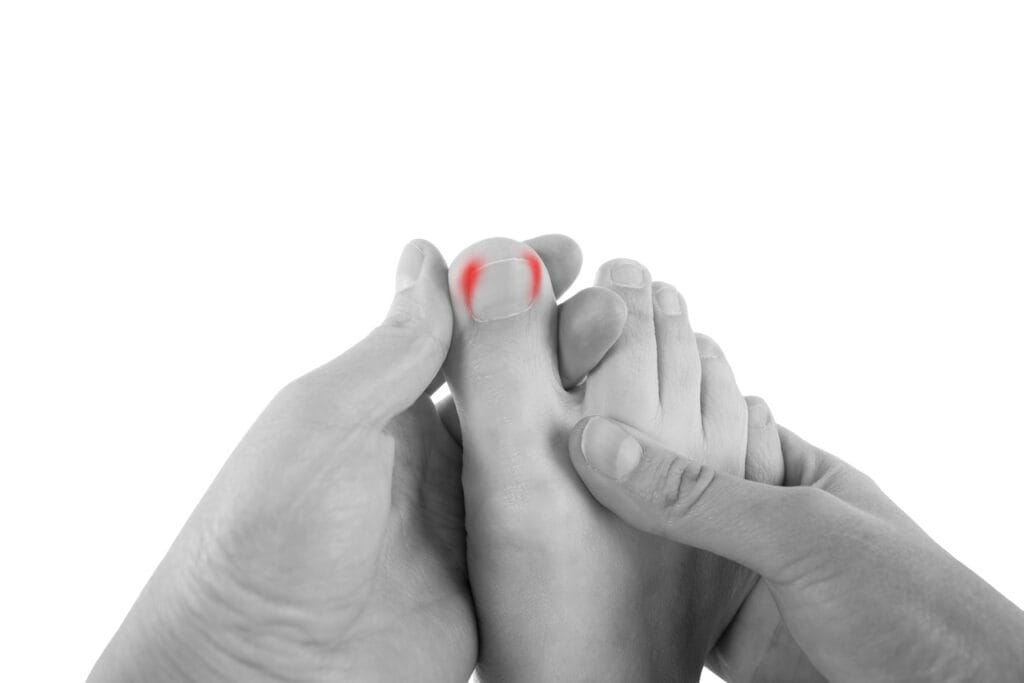
Ingrown Toenail Treatment in Newcastle
Most ingrown toenails can be resolved at your very first appointment — including pain relief and drainage of any infection. Surgery is only needed for the small percentage of cases that keep coming back.
Same-week appointments · Pain relief on day one · HICAPS on-site · No GP referral needed
Pain relief on your first visit
Most people coming to us with an ingrown toenail are limping, can't wear closed shoes, and have been losing sleep. The first goal of any appointment is to make that stop — fast.
Carefully assess the toe and confirm the diagnosis (some "ingrown" nails are actually something else, like a fungal infection or a paronychia)
Gently remove the offending nail spike that's digging into the skin
Drain any infection that's built up around the nail
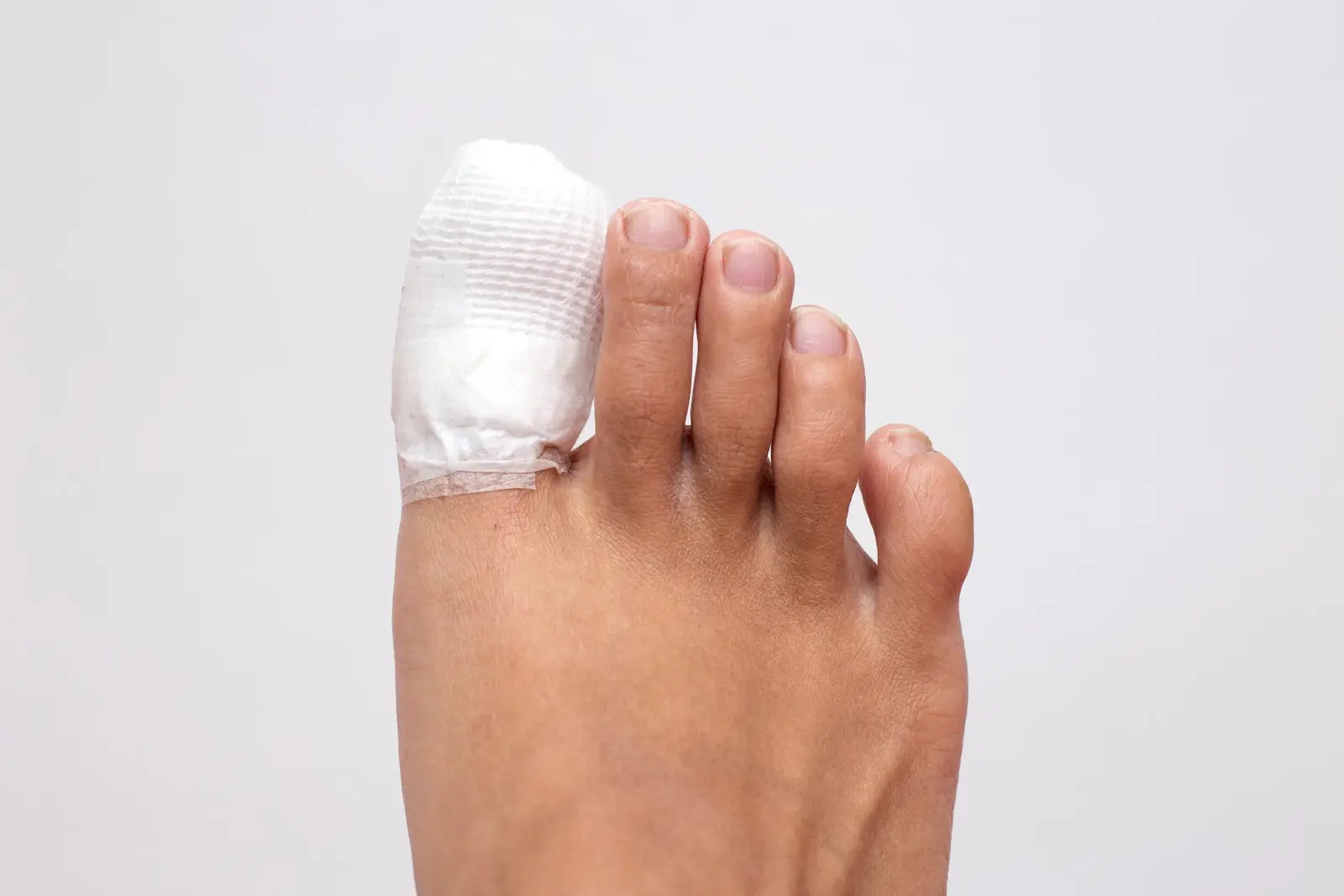
Dress the area properly so it can heal
Give you clear instructions for the next few days at home
You walk out almost always feeling dramatically better than you walked in. For around 70% of patients, this single appointment is all the treatment they’ll ever need.
What is an ingrown toenail?
An ingrown toenail (medically: onychocryptosis) happens when the edge of a toenail grows into the soft skin beside it. Most often it's the big toe. The body treats the embedded nail like a splinter — it becomes inflamed, often infected, and progressively more painful.
- Pain along one or both sides of the nail, especially with pressure
- Redness and swelling around the affected nail edge
- A noticeable lump of inflamed flesh next to the nail
- Discharge of pus or clear fluid
- Bleeding when the area is touched
- Pain when wearing closed shoes or socks
- Cutting nails too short or rounding off the corners (the most common cause we see)
- Tight, narrow, or pointed-toe shoes
- Trauma - stubbing the toe, dropping something on it, sports injuries
- Genetics - some nails are naturally curved (involuted) and prone to ingrowing
- Picking or pulling at toenails
- Excessive sweating making the skin around the nail softer
How we treat ingrown toenails
There are two paths, depending on how severe the problem is and whether it's a first-time issue or a recurring one.
For most cases: conservative treatment
If this is the first time (or first time in a long time) you've had an ingrown toenail, we almost always start conservatively. That means: removing the embedded nail spike with sterile instruments, treating any infection, and showing you how to cut your nails correctly going forward.
Conservative treatment is:
- Done in a single 20-30 minute appointment
- Usually possible without local anaesthetic, though we can numb the area if you're sensitive or the spike is deeply embedded
- Effective long-term for around 70% of patients when paired with proper nail-cutting technique afterwards

For recurring or severe cases: partial nail avulsion (minor surgery)
If the same toe keeps becoming ingrown, or the problem is severe from the start, we'll talk about a partial nail avulsion (PNA). This is a minor surgical procedure performed in our clinic under local anaesthetic. We permanently remove the problem portion of the nail — usually a 2-3mm strip down one side — and treat the underlying nail bed with a chemical called phenol so that strip doesn't grow back.
What this involves:
- Total appointment time: around 60 minutes
- Local anaesthetic injected at the base of the toe — this is the only part that hurts, and only for a few seconds
- Once the toe is numb, you feel nothing during the procedure itself
- You walk out of the appointment — drive yourself home, even
- The nail looks almost normal afterwards (slightly narrower along the treated edge — most people can't tell)
- Success rate is over 95% — this procedure typically resolves the problem permanently
Will it hurt? What to expect
Honest answer: less than you're imagining.
For conservative treatment (removing a nail spike), most patients describe it as briefly uncomfortable but a huge relief overall. The pain you're feeling from the ingrown nail itself is almost always worse than the treatment.
For partial nail avulsion under local anaesthetic, the genuinely painful part is the anaesthetic injection — about 10 seconds of sharp sting at the base of the toe. After that, you feel pressure but no pain. Most patients' first reaction afterwards is "that was way easier than I expected."
We've done thousands of these. We know exactly how to minimise discomfort, and we'll talk you through every step before it happens.
Recovery — when can I go back to work, sport, shoes?
Recovery depends on the treatment.
After conservative treatment (nail spike removal):
- Back to normal activity immediately, including work
- Comfortable in closed shoes within a day or two
- Some mild tenderness for 3-5 days
- Full healing within 7-10 days
After partial nail avulsion:
- Same-day: walk out, drive home, rest with foot elevated for the afternoon
- Day 1-2: most people take it easy at home — desk work fine, manual work probably not
- Day 3-7: most patients return to work in supportive shoes or sandals
- Week 2: back to most normal activity, light exercise
- Week 3-4: back to running, sport, and tight-fitting shoes
- Full nail bed healing: 6-8 weeks
We'll see you for a follow-up dressing change a few days after the procedure, then again at 2 weeks to check healing. After that you're back to normal life.
Cost, private health rebates & HICAPS
Most patients pay very little out of pocket. Here's how it works:
Conservative treatment appointment
Similar in cost to a standard podiatry consultation. Claimable on most private health extras policies
Partial nail avulsion
Higher due to the procedure time, sterile setup, anaesthetic, and follow-up dressings. We'll quote the total cost (procedure + follow-ups) before booking, with no surprises. Most private health extras policies cover a portion.
HICAPS on-site
So you can claim your rebate at the counter and only pay the gap.
Medicare CDM / EPC plans
If your GP has put you on a Chronic Disease Management plan, Medicare may cover part of your consultation cost. Bring your referral.
DVA & NDIS
We see patients under both programs — (NDIS call us to confirm your funding details).
Tip: ring your private health fund and ask "What's my rebate for podiatry consultation and for a partial nail avulsion?" — they'll quote both numbers.
Why ingrown toenails happen (and how to stop them coming back)
If we're treating you conservatively (without surgery), prevention is critical — otherwise you'll be back in the same spot in 6 months. The fixes are simple but most people are doing the opposite of them:
Don't cut too straight with a slight rounded corner
Cut straight across will tend to leave a sharp leading edge. Make sure the final cut is just past the edge leaving and nice corner.
Don't cut too short
Leave the white part of the nail visible. Cutting down into the pink risks the nail growing back through the skin.
Wear shoes that fit
There should be roughly a thumb-width of space between your longest toe and the end of the shoe. Pointed-toe shoes are the worst offender.
Don't pick or pull
If you can see a piece of nail you want to pull, leave it. Come and see us.
Protect the toe in sport
Properly fitted football boots, cycling shoes, etc. Trauma is a major cause.
FAQ's
Have questions about scheduling or what to expect? Here are answers to common inquiries to help you feel fully prepared.
Same-week is usual — often same-day if you call early. Ingrown toenails are treated as urgent in our schedule because of how miserable they are.
You can, but it's usually slower and you'll likely end up referred to a podiatrist anyway. GPs typically don't carry the specialised instruments for nail surgery, and a course of antibiotics won't fix the underlying mechanical problem (the nail still digs in once the infection clears).
Sometimes. If there's significant infection that we can't fully resolve by draining the area, we'll recommend you see your GP for a short course of antibiotics. We can't prescribe them ourselves, but we coordinate the referral if you need it.
Almost always, yes. The treated edge of the nail will be 2-3mm narrower, which is usually invisible unless you're comparing it to the other toe up close. Most patients are pleased with the cosmetic result.
In about 3-5% of cases, a small section can regrow. If it does, we can usually retreat that specific area easily. Overall success rate is over 95%.
Yes. We treat children and teenagers regularly. For partial nail avulsion in younger children we're especially careful with the anaesthetic injection, and parents/guardians stay throughout.
In most cases yes, but we take extra care with assessment of your circulation and healing capacity first. If you have known peripheral neuropathy or circulation problems, we may recommend a more conservative approach or coordinate with your GP first.
It's usually still fine — let us know during booking and we'll plan accordingly. We may communicate with your GP about briefly stopping certain medications around the procedure, depending on your situation.
Where are we?
East Coast Podiatry Clinic is at 2/1 Glebe Street, Kahibah — five minutes from Charlestown Square, with off-street parking. We see patients from across Newcastle and Lake Macquarie, including:
Charlestown · Kahibah · Whitebridge · Dudley · Redhead · Belmont · Gateshead · Cardiff · Glendale · Kotara · Adamstown · Mt Hutton · Warners Bay · Newcastle CBD · Merewether · The Junction · and the wider Hunter region.
Stop limping. Book today.
Ingrown toenails are one of the few things in podiatry we can fix completely in a single visit. Book online for a same-week appointment, or call us now if it's urgent.