Ehlers-Danlos Syndrome and Your Feet — A Newcastle Podiatrist’s Guide
Your ankles roll on flat ground. Your arches ache after an hour on your feet. Shoes that feel fine in the morning are uncomfortable by lunchtime, and you’ve been told more than once that you’re “just flexible.” If you’ve been diagnosed with Ehlers-Danlos syndrome (EDS) or hypermobility — or suspect you might have it — your feet are often one of the first places it shows up, and one of the places where the right support can make the biggest day-to-day difference.
What Is Ehlers-Danlos Syndrome?
Ehlers-Danlos syndrome is a group of inherited connective tissue disorders that affect collagen — the protein that gives strength and structure to skin, ligaments, tendons, joint capsules and blood vessels. When collagen is looser or more fragile than it should be, joints move further than they’re designed to, and the tissues that normally hold them steady don’t do that job as well.
There are several types of EDS, but by far the most common is hypermobile EDS (hEDS). Many people also have a closely related condition called hypermobility spectrum disorder (HSD), which shares many of the same symptoms. Diagnosis is made by your GP or a specialist such as a rheumatologist or geneticist — but a podiatrist is often the person who picks up the pattern in the feet and ankles and suggests it’s worth looking into.
How EDS Affects the Feet and Ankles
Each foot contains 26 bones and more than 30 joints, all held together by ligaments. When those ligaments are lax, the foot has to rely much more heavily on muscles to stay stable — which is tiring, and which is why symptoms often build over the course of the day. Common problems we see include:
- Flexible flat feet — the arch looks normal when sitting but collapses significantly when standing and walking, placing extra strain on the arch, heel and inner ankle
- Ankle instability and recurrent sprains — lax ligaments and reduced joint position sense (proprioception) make rolling an ankle far more likely, sometimes on nothing more than an uneven footpath
- Subluxations — small joints in the foot, and sometimes the ankle, partially slipping out of position and back again
- Bunions and toe deformities — hallux valgus and clawing or retracted lesser toes can develop earlier and progress faster
- Heel and arch pain — plantar fasciitis and tendon overload, from muscles and tendons working overtime to compensate for loose ligaments
- Foot fatigue and widespread aching — often in the arches and calves, and often worse at the end of the day
- Skin fragility — skin that bruises easily, blisters readily, and heals more slowly, which matters for corns, calluses and any break in the skin
What Happens at an EDS Foot Assessment
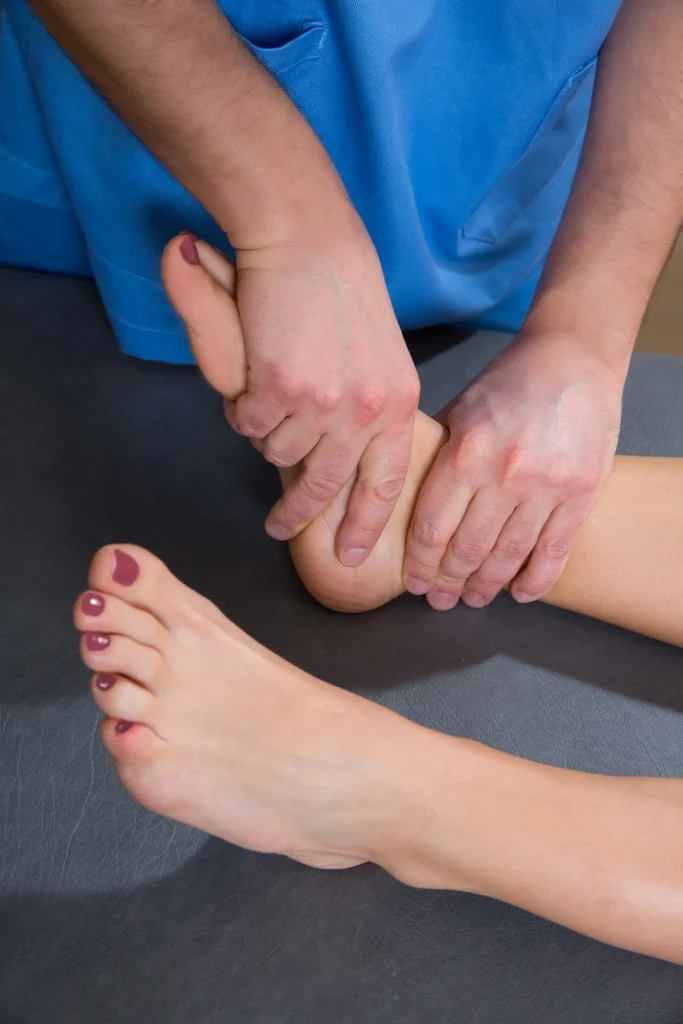
An assessment at East Coast Podiatry Clinic looks at the whole picture, not just the sore spot:
- Joint range of motion and hypermobility — assessing the foot and ankle joints, and hypermobility more broadly, including a Beighton score where appropriate
- Foot posture and gait — seeing how your feet function under load when standing and walking, not just on the treatment chair
- Strength and balance — checking the muscles that stabilise the foot and ankle, and single-leg balance and proprioception
- Skin and nail check — identifying any areas of pressure, callus, blistering or fragile skin
- Footwear review — making sure your shoes are helping rather than working against you
How We Support Feet Affected by EDS
EDS itself can’t be cured, but foot and ankle symptoms can often be managed well with the right combination of support:
- Custom 3D orthotics — your feet are 3D scanned in clinic and your orthotics are designed in-house to your individual foot shape. For hypermobile feet, the aim is supportive, well-tolerated control rather than forcing the foot into a rigid position, and the design is fine-tuned to your comfort
- Footwear advice — a firm heel counter, stable midsole and secure lacing make a noticeable difference to ankle stability and end-of-day fatigue
- Strength and proprioception exercises — targeted foot, ankle and calf exercises to help muscles do the stabilising work that lax ligaments can’t
- Ankle bracing or taping — for higher-risk activities or during periods of recurrent sprains
- Gentle skin and nail care — careful management of corns, calluses and pressure areas, with extra attention to fragile skin
- Working with your care team — liaising with your GP, physiotherapist or specialist, including under a GP Chronic Disease Management (EPC) referral where eligible
When Should You See a Podiatrist?
See us if you’re experiencing frequent ankle sprains, arch or heel pain, feet that tire or ache well before the end of the day, or if foot symptoms are limiting how far you can walk or how active you can be. It’s also worth booking if you’ve recently been diagnosed with EDS or HSD and want a baseline assessment of your foot and ankle function — addressing instability early can help reduce the cumulative strain on your joints over time.
Book Online Today
If you’re living with Ehlers-Danlos syndrome or hypermobility and your feet are holding you back, a tailored assessment is a good place to start. Book an appointment online or call us on (02) 4942 2550.